
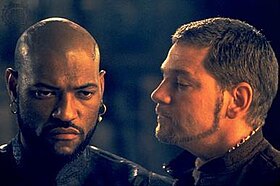
Character of Iago
Central points:
- Contempt for Othello is clear from the beginning
- Some motivation for his scheming is provided
- Duplicitous
- Discusses sex in very crude terms- ties in to his misogyny
- Opportunistic
- Exploitative
- Manipulative
- Diabolical
- Extremely cruel
- Completely remorseless and unrepentant/determined to see his plot to the end
- Remains enigmatic until the end
Overall analysis: A completely diabolical villain who exploits characters’ weaknesses and seizes any opportunity to create discord. He remains one of Shakespeare’s most heinous villains.
Iago’s contempt for Othello is established from the beginning of the play. In his discussion with Roderigo in scene one, he openly admits that he is merely waiting for an opportunity to destroy Othello ‘I follow him to serve my turn upon him.’ The audience knows, right from the beginning, that Othello cannot trust Iago.
We are never made entirely aware of Iago’s exact reasons for committing such immoral scheming, but we are provided with some of his motivations. Iago is resentful that he was passed over by Othello for a promotion to the role of lieutenant as he feels he is better suited to the role, stating ‘I know my price, I am worth no worse a place.’ He is deeply critical of Michael Cassio, the man appointed to the role, stating that he is ‘…a fellow almost damned in a fair wife that never set a squadron in the field nor the division of a battle knows.’ As well as this he suspects that both Cassio and Othello have been intimate with his wife, informing us in Act 1 ‘I hate the Moor and it is thought that ‘twixt my sheets he has done my office.’ Although Iago’s resentment over being shunned for a promotion might seem valid (he is more experienced than Cassio), his claims about his wife and the men remain unfounded.
Iago’s duplicitous nature is evident from the beginning. Iago is unapologetically deceptive and cunning, proudly stating in his first soliloquy ‘I am not what I am.’ He is aware that by being duplicitous, he has a better chance of advancing his evil plans- ‘I must show out a flag and sign of love which is indeed but sign.’ He knows that the more he can convince Othello that he is honest and trustworthy, the better opportunity he will have to influence him.
Although Iago is capable of being charming and affable to those around him, his language surrounding sex and women is coarse and vulgar. When informing Brabantio of Othello and Desdemona’s relationship, he states ‘an old black ram is tupping your white ewe.’ Indeed, it is this crude imagery that will ultimately have the biggest influence Othello. Lacking any real evidence that Cassio and Desdemona are having an affair, Iago fills Othello’s mind with coarse and vulgar sexual images. When Othello wonders if Cassio has lain with Desdemona, Iago responds ‘With her, on her, what you will’. Even publicly, though disguised as playfulness, Iago is quite misogynistic. It is clear that his view of women is clouded by mistrust, as he tells Desdemona ‘your are pictures out of doors, bells in your parlours, wildcats in your kitchens, saints in your injuries, devils being offended, plays in your housewifery and housewives in your beds.’ Thus, it is evident to the audience that Iago deeply mistrusts women, whom he views as hypocritical and deceptive.
Perhaps Iago’s most discernible trait is his opportunism. Iago is fortunate in the play in that he is presented with many opportunities to wreak havoc with the characters’ lives. He uses Roderigo not only to attack Cassio but also for his money, scornfully commenting ‘thus do I ever make my fool my purse.’ As well as this, he sees an opportunity to get Cassio drunk, leading to him losing his rank as lieutenant. While Iago does scheme in the play, his greatest strength as a villain is seizing opportunities that land in front of him. This is perhaps best conveyed to us through Desdemona’s handkerchief, which, when it falls into his possession, Iago uses as the ‘ocular proof’ Othello has asked for. While some critics consider Iago lucky in the play, he certainly makes the most of any chance he receives to scheme and plot.
Iago is brilliantly able to exploit the other characters’ various weaknesses. He is easily able to exploit Roderigo’s love of Desdemona, eventually persuading him to attack Cassio. He is also able to exploit Cassio’s love of women and his drunkenness to further his plans. Most significantly, however, Iago is able to exploit not only Othello’s deep-seated insecurities about his age and race, but also his inherently trusting nature, commenting ‘the Moor is of a free and open nature that think men honest that seem to be but so and will as tenderly be led by th’ nose as asses are.’ We know that Othello’s unquestioning trust of Iago is a huge mistake that he will later deeply regret.
To further his own selfish aims, Iago manipulates those around him in a subtle but significant manner. When he sees Cassio avoiding Othello, he comments ‘…I cannot think it that he would steal away so guilty like, seeing you coming.’ He engages in a clever balancing act with Othello; on the one hand telling him to ‘beware my lord of jealousy/it is the green-eyed monster which doth mock the meet it feeds on’ but also filling his mind with crude sexual imagery of Cassio and Desdemona. In this way, he is a master of manipulation, influencing Othello so profoundly that he will wind up murdering his wife.
It is rare in Shakespearean literature that a villain is so unapologetically diabolical. In his soliloquies, Iago provides us with an insight into just how evil he truly is. He admits that he will ‘pour this pestilence into (Othello’s) ear that (Desdemona) repeals him for her body’s lust.’ He also tells us ‘so I will turn her virtue into pitch, and out of her own goodness make the net that shall enmesh them all.’ His diabolical scheming is unrestrained and dangerous, but a source of fascination to the audience, firmly placing Iago at the top of the list of Shakespeare’s most notorious villains.
Not only is Iago a diabolical schemer, he is capable of great cruelty. He kills his own wife without question, stabbing her as she reveals his lies. He is also the person to suggest that Othello smother his wife ‘Do it not with poison. Strangle her in her bed even the bed she hath contaminated.’ Iago’s cruel streak serves to make him an even more intimidating villain.
Notably, and in contrast to Edmund in Lear, Iago remains remorseless and unrepentant. In Act 4, he states ‘thus credulous fools are caught and many worthy and chaste dames even thus all guiltless meet reproach.’ In Act 5, he remains determined to see his plans through, noting ‘this is the night that either make me or fordoes me quite.’ For Iago, there is no moment of repentance or doubt and he never seeks nor is given any form of redemption.
Indeed, Iago remains enigmatic right to the end. His last words in the play are ‘demand me nothing. What you know, you know. From this time, I will never speak word.’ Iago is unwilling to provide the audience with any deep insights into his motivations and, although frustrating, is no doubt one of the many reasons for his enduring appeal as a Shakespearean villain.


 Ms Cotter's Class
Leave a comment