
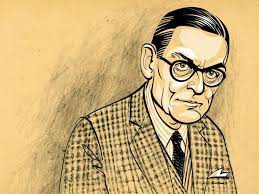
T.S. Eliot Ms. C. Cotter
A link to a Google Doc of this booklet which can be printed:

Thomas Stearns Eliot was born in 1888 in Missouri to a Bostonian family.
Educated at Harvard and later completed graduate work at Oxford.
Eventually settled in England and became a British citizen in 1927.
Converted to Anglicanism.
Worked as an editor (and later director) for Faber and Faber.
The Lovesong of J. Alfred Prufrock was published in 1915 and is an early example of modernist poetry. The Wasteland was published in 1922.
Recipient of Nobel Prize for literature in 1948.
Died in 1965 in London.
A quick note on Modernism:
Modernism as a movement began in the late 19th and early 20th century as a response to many factors, including the emergence of global capitalism, advances in social sciences, industrialisation and the First World War.
It contrasts with the morality of the Victorian era and with the idealism of the Romantic era (following the horrors of the First World War and the influence of industrialism and urbanisation)
Disillusionment and alienation are frequent themes
Stylistically, modernist literature can be challenging as it is rather fragmented and streams of consciousness became popular
Key works: Ulysses, The Great Gatsby, Of Mice and Men
The Lovesong of J. Alfred Prufrock
S’io credesse che mia risposta fosse
A persona che mai tornasse al mondo,
Questa fiamma staria senza piu scosse.
Ma percioche giammai di questo fondo
Non torno vivo alcun, s’i’odo il vero,
Senza tema d’infamia ti rispondo.
Let us go then, you and I,
When the evening is spread out against the sky
Like a patient etherized upon a table;
Let us go, through certain half-deserted streets,
The muttering retreats
Of restless nights in one-night cheap hotels
And sawdust restaurants with oyster-shells:
Streets that follow like a tedious argument
Of insidious intent
To lead you to an overwhelming question …
Oh, do not ask, “What is it?”
Let us go and make our visit.
In the room the women come and go
Talking of Michelangelo.
The yellow fog that rubs its back upon the window-panes,
The yellow smoke that rubs its muzzle on the window-panes,
Licked its tongue into the corners of the evening,
Lingered upon the pools that stand in drains,
Let fall upon its back the soot that falls from chimneys,
Slipped by the terrace, made a sudden leap,
And seeing that it was a soft October night,
Curled once about the house, and fell asleep.
And indeed there will be time
For the yellow smoke that slides along the street,
Rubbing its back upon the window-panes;
There will be time, there will be time
To prepare a face to meet the faces that you meet;
There will be time to murder and create,
And time for all the works and days of hands
That lift and drop a question on your plate;
Time for you and time for me,
And time yet for a hundred indecisions,
And for a hundred visions and revisions,
Before the taking of a toast and tea.
In the room the women come and go
Talking of Michelangelo.
And indeed there will be time
To wonder, “Do I dare?” and, “Do I dare?”
Time to turn back and descend the stair,
With a bald spot in the middle of my hair —
(They will say: “How his hair is growing thin!”)
My morning coat, my collar mounting firmly to the chin,
My necktie rich and modest, but asserted by a simple pin —
(They will say: “But how his arms and legs are thin!”)
Do I dare
Disturb the universe?
In a minute there is time
For decisions and revisions which a minute will reverse.
For I have known them all already, known them all:
Have known the evenings, mornings, afternoons,
I have measured out my life with coffee spoons;
I know the voices dying with a dying fall
Beneath the music from a farther room.
So how should I presume?
And I have known the eyes already, known them all—
The eyes that fix you in a formulated phrase,
And when I am formulated, sprawling on a pin,
When I am pinned and wriggling on the wall,
Then how should I begin
To spit out all the butt-ends of my days and ways?
And how should I presume?
And I have known the arms already, known them all—
Arms that are braceleted and white and bare
(But in the lamplight, downed with light brown hair!)
Is it perfume from a dress
That makes me so digress?
Arms that lie along a table, or wrap about a shawl.
And should I then presume?
And how should I begin?
Shall I say, I have gone at dusk through narrow streets
And watched the smoke that rises from the pipes
Of lonely men in shirt-sleeves, leaning out of windows? …
I should have been a pair of ragged claws
Scuttling across the floors of silent seas.
And the afternoon, the evening, sleeps so peacefully!
Smoothed by long fingers,
Asleep … tired … or it malingers,
Stretched on the floor, here beside you and me.
Should I, after tea and cakes and ices,
Have the strength to force the moment to its crisis?
But though I have wept and fasted, wept and prayed,
Though I have seen my head (grown slightly bald) brought in upon a platter,
I am no prophet — and here’s no great matter;
I have seen the moment of my greatness flicker,
And I have seen the eternal Footman hold my coat, and snicker,
And in short, I was afraid.
And would it have been worth it, after all,
After the cups, the marmalade, the tea,
Among the porcelain, among some talk of you and me,
Would it have been worth while,
To have bitten off the matter with a smile,
To have squeezed the universe into a ball
To roll it towards some overwhelming question,
To say: “I am Lazarus, come from the dead,
Come back to tell you all, I shall tell you all”—
If one, settling a pillow by her head
Should say: “That is not what I meant at all;
That is not it, at all.”
And would it have been worth it, after all,
Would it have been worth while,
After the sunsets and the dooryards and the sprinkled streets,
After the novels, after the teacups, after the skirts that trail along the floor—
And this, and so much more?—
It is impossible to say just what I mean!
But as if a magic lantern threw the nerves in patterns on a screen:
Would it have been worth while
If one, settling a pillow or throwing off a shawl,
And turning toward the window, should say:
“That is not it at all,
That is not what I meant, at all.”
No! I am not Prince Hamlet, nor was meant to be;
Am an attendant lord, one that will do
To swell a progress, start a scene or two,
Advise the prince; no doubt, an easy tool,
Deferential, glad to be of use,
Politic, cautious, and meticulous;
Full of high sentence, but a bit obtuse;
At times, indeed, almost ridiculous—
Almost, at times, the Fool.
I grow old … I grow old …
I shall wear the bottoms of my trousers rolled.
Shall I part my hair behind? Do I dare to eat a peach?
I shall wear white flannel trousers, and walk upon the beach.
I have heard the mermaids singing, each to each.
I do not think that they will sing to me.
I have seen them riding seaward on the waves
Combing the white hair of the waves blown back
When the wind blows the water white and black.
We have lingered in the chambers of the sea
By sea-girls wreathed with seaweed red and brown
Till human voices wake us, and we drown
Aunt Helen
Miss Helen Slingsby was my maiden aunt,
And lived in a small house near a fashionable square
Cared for by servants to the number of four.
Now when she died there was silence in heaven
And silence at her end of the street.
The shutters were drawn and the undertaker wiped his feet—
He was aware that this sort of thing had occurred before.
The dogs were handsomely provided for,
But shortly afterwards the parrot died too.
The Dresden clock continued ticking on the mantelpiece,
And the footman sat upon the dining-table
Holding the second housemaid on his knees—
Who had always been so careful while her mistress lived.
II. A Game of Chess
The Chair she sat in, like a burnished throne,
Glowed on the marble, where the glass
Held up by standards wrought with fruited vines
From which a golden Cupidon peeped out80
(Another hid his eyes behind his wing)
Doubled the flames of sevenbranched candelabra
Reflecting light upon the table as
The glitter of her jewels rose to meet it,
From satin cases poured in rich profusion;85
In vials of ivory and coloured glass
Unstoppered, lurked her strange synthetic perfumes,
Unguent, powdered, or liquid—troubled, confused
And drowned the sense in odours; stirred by the air
That freshened from the window, these ascended90
In fattening the prolonged candle-flames,
Flung their smoke into the laquearia,92
Stirring the pattern on the coffered ceiling.
Huge sea-wood fed with copper
Burned green and orange, framed by the coloured stone,95
In which sad light a carvèd dolphin swam.
Above the antique mantel was displayed
As though a window gave upon the sylvan scene98
The change of Philomel, by the barbarous king99
So rudely forced; yet there the nightingale100
Filled all the desert with inviolable voice
And still she cried, and still the world pursues,
And other withered stumps of time
Were told upon the walls; staring forms105
Leaned out, leaning, hushing the room enclosed.
Footsteps shuffled on the stair.
Under the firelight, under the brush, her hair
Spread out in fiery points
Glowed into words, then would be savagely still.
110
“My nerves are bad to-night. Yes, bad. Stay with me.
“Speak to me. Why do you never speak? Speak.
“What are you thinking of? What thinking? What?
“I never know what you are thinking. Think.”
Where the dead men lost their bones.
“What is that noise now? What is the wind doing?”
Nothing again nothing.
120
“Do
“You know nothing? Do you see nothing? Do you remember
“Nothing?”
Those are pearls that were his eyes.125
“Are you alive, or not? Is there nothing in your head?”
But
O O O O that Shakespeherian rag—
130
“What shall I do now? What shall I do?”
“I shall rush out as I am, and walk the street
“With my hair down, so. What shall we do tomorrow?
“What shall we ever do?”
135
And if it rains, a closed car at four.
And we shall play a game of chess,
Pressing lidless eyes and waiting for a knock upon the door.
When Lil’s husband got demobbed, I said—
I didn’t mince my words, I said to her myself,140
Now Albert’s coming back, make yourself a bit smart.
He’ll want to know what you done with that money he gave you
To get yourself some teeth. He did, I was there.
You have them all out, Lil, and get a nice set,145
He said, I swear, I can’t bear to look at you.
And no more can’t I, I said, and think of poor Albert,
He’s been in the army four years, he wants a good time,
And if you don’t give it him, there’s others will, I said.
Oh is there, she said. Something o’ that, I said.150
Then I’ll know who to thank, she said, and give me a straight look.
Hurry up please its time
If you don’t like it you can get on with it, I said.
Others can pick and choose if you can’t.
But if Albert makes off, it won’t be for lack of telling.155
You ought to be ashamed, I said, to look so antique.
(And her only thirty-one.)
I can’t help it, she said, pulling a long face,
It’s them pills I took, to bring it off, she said.
(She’s had five already, and nearly died of young George.)160
The chemist said it would be all right, but I’ve never been the same.
You are a proper fool, I said.
Well, if Albert won’t leave you alone, there it is, I said,
What you get married for if you don’t want children?
Hurry up please its time165
Well, that Sunday Albert was home, they had a hot gammon,
And they asked me in to dinner, to get the beauty of it hot—
Hurry up please its time
Hurry up please its time
Goonight Bill. Goonight Lou. Goonight May. Goonight.170
Ta ta. Goonight. Goonight.
Good night, ladies, good night, sweet ladies, good night, good night.
Preludes
I
The winter evening settles down
With smell of steaks in passageways.
Six o’clock.
The burnt-out ends of smoky days.
And now a gusty shower wraps
The grimy scraps
Of withered leaves about your feet
And newspapers from vacant lots;
The showers beat
On broken blinds and chimney-pots,
And at the corner of the street
A lonely cab-horse steams and stamps.
And then the lighting of the lamps.
II
The morning comes to consciousness
Of faint stale smells of beer
From the sawdust-trampled street
With all its muddy feet that press
To early coffee-stands.
With the other masquerades
That time resumes,
One thinks of all the hands
That are raising dingy shades
In a thousand furnished rooms.
III
You tossed a blanket from the bed,
You lay upon your back, and waited;
You dozed, and watched the night revealing
The thousand sordid images
Of which your soul was constituted;
They flickered against the ceiling.
And when all the world came back
And the light crept up between the shutters
And you heard the sparrows in the gutters,
You had such a vision of the street
As the street hardly understands;
Sitting along the bed’s edge, where
You curled the papers from your hair,
Or clasped the yellow soles of feet
In the palms of both soiled hands.
IV
His soul stretched tight across the skies
That fade behind a city block,
Or trampled by insistent feet
At four and five and six o’clock;
And short square fingers stuffing pipes,
And evening newspapers, and eyes
Assured of certain certainties,
The conscience of a blackened street
Impatient to assume the world.
I am moved by fancies that are curled
Around these images, and cling:
The notion of some infinitely gentle
Infinitely suffering thing.
Wipe your hand across your mouth, and laugh;
The worlds revolve like ancient women
Gathering fuel in vacant lots.
An Overview of the Poetry of T.S. Eliot
Thomas Stearns Eliot remains one of the most influential twentieth century poets. A seminal modernist writer, Eliot wrote during a time of great global upheaval that was characterised by the spread of capitalism, indutrialisation and war. This is reflected in his poetry, where themes of alienation, stifled communication and urbanisation abound. Eliot wrote poetry that was considered rather shocking in the early twentieth century- as society emerged from the Victorian era, allusions to substance abuse, sex and the seediness of urban life were initally considered rather taboo. Eliot’s poetic style, while sometimes confounding, was new and fresh as his fragmented, stream of consciousness prose became typical of the modernist writers who emerged following the First World War.
The Lovesong of J. Alfred Prufrock is perhaps Eliot’s best-known work. The poem is written as the lengthy, dithering monologue of its titular character. The name J. Alfred Prufrock reminds us of Eliot’s own triple name, while the surname Prufrock possibly suggests prudishness and femininity (frock meaning dress). Before we even read the poem, the name in and of itself suggests someone middle class and educated, if not a little pretentious.
The epigraph to the poem, written in Italian, comes from Dante’s Inferno. In the famous poem, an inhabitant of the eight circle of hell reveals his terrible crimes as he states that he can do so because noone has ever returned to earth from hell, and therefore his reputation will remain intact.This short piece sets up the central conflict of the poem: fear of consequences following honest and intimate revelation.
The poem begins with Eliot inviting the reader on a journey, which appears to be both symbolic and literal. Eliot skilfully establishes a seedy urban setting which immediately feels rather confining. In a brilliant simile, Eliot compares the evening sky to a patient ‘etherized upon a table’. This bizarre and somewhat disturbing image is an early indication of the paralysation of the protagonist- Prufrock is immobilised by his own inaction. He establishes the anti-aesthetic detail that will characterise the poem early on- the mentions of ‘one-night cheap hotels’ and ‘sawdust restaurants with oyster-shells’ are not attractive images. Themes of alienation and isolation also emerge, as well as one of the poem’s central themes: stifled communication. He describes the ‘muttering’ he hears as he makes his journey through the streets. The reference to ‘restless nights’ in cheap hotels is a possible allusion to sex work and it is possible that we are walking through the city’s Red Light District. As we continue our journey with the speaker, we realise that it is more than a physical one- we are being led to ‘an overwhelming’ question. Rather than tell us what this question is, Prufrock urges us to resist asking him. Instead, we continue on our journey.
The rhyming couplet which follows appears random and indicates the fragmentary style of the poem. In the context of the poem, however, it makes sense. Prufrock tells us ‘in the room the women come and go, talking of Michelangelo.’ The subject matter, Italian High Renaissance art, appears to be a suitable topic for middle class women to discuss but it also seems rather pretentious and shallow as they ‘come and go’ from a room, potentially at a party. It is also notable that Prufrock notices just the women and indeed does not interact with them. He will repeat this couplet later on, which betrays the mononotony of this society.
In lines 15-22, Eliot uses wonderful feline imagery to describe the urban fog. Although the fog is described as ‘yellow’, there is something almost comforting about the image as the fog ‘curled once about the house and fell asleep.’ Once more, the imagery contributes wonderfully to the overall urban atmosphere.
Eliot follows this stanza with the statement ‘there will be time.’ This is in fact a literary reference to a poem entitled ‘To His Coy Mistress’ by Andrew Marvell. In the poem, a man is aiming to convince a woman to have sex with him but she is being rather relucant, or coy. Marvell’s speaker is saying that if they had infinite time, it would be acceptable to be coy, but they do not, so it isn’t. Prufrock, however, is repeating to himself that there is indeed time for him to ask his question (he repeats the phrase as though he is trying to convince himself). It is worth noting that this statement follows an entire stanza that describes the fog- Prufrock isn’t exactly in a rush to ask his ‘overwhelming question’. The allusion to Marvell’s poem is also a significant hint: is Prufrock’s question a proposition to a woman?
Prufrock next tells us that ‘there will be time…to prepare a face to meet the faces that you meet.’ Once more, this reveals to us the disingenuous nature of this society- the public persona is markedly different to the private and requires effort to socialise according to the etiquette of the time. In another literary allusion, Prufrock refers to the ‘works and days of hands.’ ‘Works and Days’ is a poem by the Greek poet Hesiod which stresses the importance of hard work and the avoidance of a lazy, pointless life. Eliot is reinforcing to us the banality and meaninglessness of Prufrock’s life. There is indeed time for Prufrock to agonise over and revise his question, as he states himself, ‘before the taking of a toast and tea.’ The word toast here has two meanings: it refers to both the food and the act of making a toast. Both this and the mention of tea remind us of Prufrock’s upper class life, which is characterised by repetition in the form of meaningless social gatherings.
Indeed, Prufrock is paranoid that the people he socialises with gossip about him.He appears to be concerned about his reputation (a lovely call-back to the epigraph) He is still agonising about asking his question, repeating the phrase ‘do I dare?’ but he imagines he will instead ‘turn back and descend the stair’. Prufrock is well-dressed in a morning coat and necktie but he imagines the other people in the room will comment negatively on his appearance, stating that his ‘hair is growing thin’ as well as his ‘arms and legs.’ The disembodiment of Prufrock and the people who observe him is rather unsettling. He describes the ‘eyes’ that fix him ‘in a formulated phrase.’ He feels trapped and vulnerable, as he describes feeling like he is ‘sprawling on a pin’ and ‘pinned and wriggling on the wall.’ This reminds us of the opening simile, as Prufrock is completely paralysed by social anxiety. Prufrock feels completely restricted by what he perceives as constant observance and judgement. If his life is so restrictive and repetitive, he wonders, how is he possibly going to change? For him, this question will ‘disturb the universe.’ To us, this appears to be a rather hyperbolic statement, but in Prufrock’s world, any deviation from the socially accepted norm is potentially humiliating.
The minutiae of his life is once more reinforced as he describes the ‘evenings, mornings, afternoons’ and he tells us that he has ‘measured out (his) life with coffee spoons.’ The themes of isolation and alienation are also once more reinforced in this stanza, as Prufrock describes the ‘voices dying with a dying fall beneath the music from a farther room.’ It seems that he is completely detached and separate from the people around him, whom he only references in terms of their constituent body-parts.
He includes anti-aesthetic detail to convey the tedium of his life, which he describes as the ‘butt-ends of (his) days and ways.’ Prufrock continues to disembody the people who surround him, though this time it is womens’ arms that distract him. He describes them as ‘bracleted and white and bare’, which once more reminds us of their high-status. He adds that in the lamplight, they are ‘downed with light brown hair.’ It is worth noting that Prufrock clearly pays a lot of attention to these womens’ arms, possibly because he is uncomfortable making eye contact (although he is conscious of their eyes on him). Once more, this suggests to us that his ‘overwhelming question’ has something to do with a woman, as he appears wholly preoccupied with the women in the poem. Prufrock acknowledges this himself in the following line, as he muses ‘is it perfume from a dress that makes me so digress?’
He continues to agonise over his question- now he wonders how he should open the conversation with the person he intends to ask the question to. He wonders if he should tell them that he has wandered through the streets at dusk and ‘watched the smoke that rises from the pipes of lonely men in shirt sleeves leaning out of windows’. The reference to lonely men is interesting- it is possible that Prufrock is alluding to lonely men as he himself identifies with them but does not want to end up that way and is therefore making some sort of proposition. He does not, however, finish this train of thought, as he once more digresses, although he chastises himself for doing so with a rather self-loathing statement. Prufrock is entirely aware of his inability to act, and states that he should have been a ‘pair of ragged claws scuttling across the floors of silent seas.’ Once more, the disembodied image is unsettling and it is clear that Prufrock is struggling with deep feelings of insecurity and inadequacy. The sibilance present in this statement echoes the silence which permeates the line: Prufrock feels he should have been something that ‘scuttles’ awkwardly deep down on the ocean floor, far removed from society.
Prufrock continues to describe the tedium of his life through ‘tea and cakes and ices’ although this is contrasted by his agonised uncertainty as he describes how he has ‘wept and fasted, wept and prayed’. He also alludes to the biblical narrative of John the Baptist, who was beheaded and served to Salome on a platter after she specifically requested it. Prufrock sees his question as a potentially similar humiliation.
Prufrock feels that his best days are behind him, and that the ‘eternal footman’, will ‘snicker’ at him when he dies. In an unusually concise statement, he admits to being ‘afraid.’
Interestingly, Prufrock now changes tenses and it appears that he has passed up on the opportunity to ask his question as he wonders ‘would it have been worth it…’ There are more references to his upper class life, characterised by ‘cups’, ‘marmalade’, ‘tea’ and ‘porcelain’. He wonders if he had ‘squeezed the universe into a ball’ and asked his question, would he regret it. He knows that there is no possible way of knowing this, just like it is not possible to return from the dead to speak about the afterlife, like Lazurus whom he alludes to, or the sinner in the epigraph. Instead, he imagines that if he had asked the woman his question, she may have reacted rather negatively by stating this he misinterpreted her motives. It is possible that Prufrock feels a woman he is attracted to is encouraging him to make romantic advances but he is terrified that he is misinterpreting the signals and imagines that this is what she will inevitably tell him: ‘that is not what I meant at all, that is not it, at all.’ The following stanza is similar in that Prufrock once more describes the minutiae of his life in terms of ‘novels… teacups…skirts that trail along the floor’ but he becomes rather frustrated with himself and states ‘it is impossible to say just what I mean.’ He once more imagines the humiliation of revealing his innermost thoughts to this woman (which he likens to his nerves being projected in patterns on a magic lantern) only to be rejected. The theme of poor communication will recur throughout Eliot’s poetry and is indeed in full view here. Prufrock feels he may have misinterpreted the woman, and he himself struggles to articulate his feelings. Indeed, we never learn the contents of the question he is agonising over.
As the poem comes to a close, Prufrock acknowledges that he is ‘not Prince Hamlet.’ Although Hamlet also procrastinated and agonised over decisions, he is the central character of the play. Prufrock does not even view himself as a central character in his own life. He is ‘an attendant lord’, a character possibly not even worthy of a name and who appears for only a brief time, possibly to begin a scene. He is ‘deferential, glad to be of use’ but is not considered important. Prufrock reveals admirable self-awareness as he states he is ‘full of high sentence but a bit obtuse’ and we have no choice but to agree- the poem reveals a man who although educated and cultured is ineffectual and pretentious. He sees himself as ‘the Fool’ (possibly Polonius). As we approach the end of the poem, it appears that Prufrock has accepted his failure to ask the question.
Indeed, the questions which he666777 poses for the remainder of the poem appear rather foolish and unimportant by comparison. He wonders if he should dare to ‘part (his) hair behind’ or ‘eat a peach.’ Prufrock feels that eating a peach could be potentially embarrassing, as it is a soft and moist fruit and could make him appear messy or sloppy, although it could also have sexual connotations. The poem ends with a rather dream-like sequence and it appears that he is escaping from his uncomfortable reality. The women of his world are replaced by ‘mermaids’ and ‘sea-girls’ but even here, he states ‘I do not think that they will sing to me.’ He is pulled out of this reverie by the ‘human voices’ which surround him. For Prufrock, there is no escaping his tedious, routined life.
In ‘Aunt Helen’, Eliot expresses similar themes of stifled communication, isolation and the tedium caused by the routine of an upper class existence. Similar to Prufrock, the speaker of the poem appears rather detached and emotionless. While it is his Aunt who died, he does not express any form of sadness. She remained a single, childless woman and when she passed ‘there was silence in heaven and silence at the end of the street.’ This is possibly a kind of deferential silence, but it is more likely an expression of proper and appropriate behaviour in an upper-class area that is devoid of any real feelings of sadness. There is no strong emotion expressed by anyone in her life. Aunt Helen lived a comfortable life near a ‘fashionable square’ and was ‘cared for by servants to the number of four.’ The speaker describes the events following her death: ‘the shutters were drawn and the undertaker wiped his feet’. Even in death, Eliot stresses the importance of etiquette. Her death is a private matter and so the shutters deter nosy neighbours. The undertaker remembers to wipe his feet as he enters her home, though he is merely going about his job. The speaker tells us that her dogs were ‘handsomely provided for’ and that ‘shortly afterwards the parrot died too.’ Aunt Helen clearly had a close relationship with her pets. It is significant that she kept a parrot, a bird known for mimicking human speech, and it is possible that the bird and Aunt Helen spoke to one another. Without its companion, the parrot has no reason to live. The speaker speaks about his aunt and the parrot in an equally detached tone. Following her death, life continued as the ‘Dresden clock continued ticking on the mantlepeice.’ The poem ends with a description of Aunt Helen’s ‘second housemaid’ sitting on the knee of her footman. The fact that Aunt Helen numbered her housemaids reveals to us the rigid structure of ehr household. Now that she is gone, her servants can behave rather inappropriately, something Helen would have disapproved of. Their behaviour, in the context of the poem and its society, is rather shocking and conveys to us their indifference to their mistress’s death. Similarly to Prufrock, the poem conveys a restrictive and etiquette-driven society that causes isolation and detachment.
II A Game of Chess is taken from Eliot’s poem The Wasteland. The title itself is taken from two plays written by playwright Thomas Middleton in the seventeenth century in which moves in a game of chess represent the stages of seduction. It is perhaps Eliot’s most stylistically experimental poem. It opens with a description of the surroundings of an upper class woman, who sits on a ‘burnished throne’, a reference taken from Shakespeare’s Antony and Cleopatra to signify this woman’s high status. She is surrounded by incredibly ornate decorations and jewels such as ‘a sevenbranched candelabra.’ There is something sinister and excessive about the space however, which lends an almost threatening tone to this section. Her ‘strange synthetic perfumes…troubled, confused and drowned the sense in odours’. On the ceiling reflects a ‘sad light’ in which a ‘carved dolphin swam.’ The speaker also describes ‘other withered stumps of time’ as ‘staring forms leaned out, leaning, hushing the room enclosed.’ The carvings in the room are portrayed as invasive and excessive. Perhaps the most significant piece of art in the room is ‘The Change of Philomela.’ This is an allusion to Ovid’s Metamorphoses, which tells the tale of Philomela, a woman who is raped by her sister’s husband, the King. To deter her from revealing his brutality, he cuts out her tongue. With her sister, Philomela plots revenge and feeds the King’s son to him without him knowing. She is then transformed into a nightingale. As stifled communication is such a prominent theme in Eliot’s poetry, it is no mystery as to why he alludes to this tragic tale. Even as a bird, Philomela’s song is heard as ‘jug jug to dirty ears’. The woman in this part of the poem feels misunderstood. As someone approaches, her long hair ‘spread out in fiery points’ as it is not styled and this almost serves as a form of self-expression as it ‘glowed into words’ but not quite- it becomes ‘savagely still.’ The form of the poem begins to disintegrate as the woman desperately questions her lover. She informs him that her ‘nerves are bad tonight.’ She desperately attempts to get him to communicate with her, asking him ‘why do you never speak?’ and ‘What are you thinking of?’ The man (assumed to be the speaker) replies with the rather morbid statement ‘I think we are in rats’ alley where the dead men lost their bones’. This statement contrasts significantly with the ornately furnished room they are in and is a possible reference to the trenches of the First World War, which was one of the central causes of the emergence of modernist poetry. The woman remains agitated and nervous, asking ‘What is that noise now? What is the wind doing?’ The man’s reply (‘nothing again nothing’) is interesting. In one sense, it serves to attempt to comfort his lover but it also reinforces the nihilistic tone of the poem. The man appears subdued, as the woman comments ‘Are you alive, or not? Is there nothing in your head?’ Eliot then references a contemporary jazz song, as the woman feels that is all the man thinks about. She threatens to leave the house and ‘walk the street with (her) hair down’ but she refrains from doing so. Once more, repression and restraint are brought to the fore. In this sense, the woman is rather reminiscent of Prufrock. This section of the poem ends with a similarly tedious routine to Prufrock’s- the speaker describes the monotony of their day as they ‘play a game of chess, pressing lidless eyes and waiting for a knock upon the door.’ This knock may symbolise death- like Prufrock, this cycle will continue until the lovers die.
There is a significant contrast between the first section and the second section of the poem. The second part of the poem takes place in a working class London pub and recounts a conversation between a woman and her friends as she in turn shares a conversation she had with her friend Lil. While the barman urges the patrons to finish their drinks by shouting ‘HURRY UP PLEASE IT’S TIME’, the woman states that she advised Lil to ‘make (herself) a bit smart’ and to ‘get (herself) some teeth.’ The woman feels that Lil’s husband, Albert, will be tempted by other women if Lil doesn’t fix her increasingly ragged appearance. Lil tells her that the reason for her haggard appearance is the pills she took to ‘bring it off’, a slang term for an abortion. Lil has had five children by Albert and clearly does not want more. Since taking the pills, she confesses that she has ‘never been the same.’ The woman recounting the tale states that Albert ‘won’t leave (Lil) alone’. This overtly sexual image contrasts sharply with the repressed sexuality of the woman in the opening part of the poem, although the implications of forced sexual activity (through references to Philomela in the opening part) recur throughout the poem. The woman does not entirely finish her story, as the patrons are forced to leave the pub.
While the first half of the poem is replete with cultural references and descriptions of expensive decorations, this part of the poem is markedly plain and rather crude by comparison. This contrast is also reflected in the different language used in both sections. The opening section begins in iambic pentameter, which reflects the artistic and cultural references surrounding the woman. Imabic pentameter is often used by Shakespeare to denote characters who are well-spoken and educated. As the verse develops, however, the iambic pentameter disintegrates, reflecting the increasingly erratic mood of the woman and the stifled communication that exists between her and her lover. The second part of the poem contains no iambic pentameter, as the woman speaking in the pub is from a different social background and instead speaks in the vernacular of the working class. Despite this, Eliot does allude to Shakespeare, closing the poem with a reference to Ophelia in Hamlet (‘good night ladies, good night, sweet ladies, good night, good night’). Ophelia, like Cleopatra who was alluded to in the opening lines, also died by suicide. This connects our two female characters in the poem, even if they exist in completely different social classes.
Preludes, much like Eliot’s other poetry, also critiques the alienation caused by modern urban life. The poem consists of a series of vignettes which represent the different times of day in a cityscape. The first prelude opens with a pathetic fallacy, as the speaker states that the ‘winter evening settles down’. He describes ‘the smell of steaks in passageways’ as people prepare for dinner. We are given an exact time: it is six o’clock. The verse becomes progressively more full of anti-aesthetic detail as Eliot describes ‘the burnt-out ends of smoky days.’ This quote is reminiscent of Prufrock’s reference to the ‘butt-ends of (his) days and ways.’ The city’s inhabitants are tired or ‘burnt out’ but it is also, of course, a reference to smoking as well as to the smoke from factories commonly associated with England’s industrial cities. Signs of decay abound, as he describes how the rain ‘wraps the grimy scraps of withered leaves about your feet’. By using the second person narrative, we are being directly drawn into this ugly urban setting. The atmosphere is one of decay, waste and loneliness as he describes ‘vacant lots’ and ‘broken blinds and chimney pots.’ As the lamps are lit, ‘a lonely cab-horse steams and stamps.’ The sibilant sounds which occur throughout prelude 1 add to the sinister tone of the poem, as the observer watches the cities inhabitants from afar.
The second prelude is brief and details the city in the morning. It is no less unattractive, and once more Eliot utilises pathetic fallacy to describe it as it ‘comes to consciousness.’ There are ‘faint stale smells of beer’ from the night before. The reference to the ‘sawdust-trampled street reminds us of the sawdust floors in Prufrock and the word ‘trampled’ suggests a large population that rushes about with their ‘muddy feet.’ In a style typical of Eliot, the city’s population are referred to here by their ‘feet’ and ‘hands’, a technique known as synecdoche. They are ‘masquerades’, never quite revealing their true selves to one another. The feet rush to work as the hands raise ‘dingy shades in a thousand furnished rooms.’ Once more, we are reminded of the widespread poverty that exists in urban settings as the reference is to ‘rooms’ and not houses. With the lifting of these shades, we are given a glimpse into the lives of these people, and inside is no less unnattractive than outside.
Prelude III appears to be addressed directly to a woman, more than likely a prostitute. She tosses her blanket from her bed as she ‘lay upon (her) back and waited’. As she dozes, she ‘watches the night revealing the thousand sordid images or which (her) soul was constituted.’ Here, the speaker is saying that the woman relives her debased existence as she watched the images of her actions as they ‘flickered against the ceiling’. These ‘sordid images’ are the contents of this woman’s soul. In the morning, she hears the ‘sparrows in the gutters.’ This isn’t a particularly pleasant image, as the word ‘gutters’ debases the beauty of the sparrow image. The speaker feels that this woman, though living a ‘sordid’ existence, has a deep, almost spiritual connection with the city as she ‘had such a vision of the street as they street hardly understands.’ Here, the street represents the entirety of the world and through her work, the woman meets all kinds of people. She repeats the same cycle again and again, and therefore, meets many of the city’s inhabitants, thus providing her with a deeper insight into urban life. As she sits on the edge of the bed, she removes the curling papers from her hair, a nice reference to the newspapers in the first prelude and another reminder of this woman’s lowly social status. The last two lines of this prelude are interesting, as the speaker writes ‘…or clasped the yellow soles of feet in the palms of both soiled hands.’ This is a particularly unattractive image and it is worth noting that Eliot does not refer to the feet as necessarily belonging to the woman. Consequently, it can be assumed that these feet represent her numerous clients (Eliot has already used synecdoche to refer to the repeated trampling of the street each morning). These yellowed feet could refer to the men who visit this woman. It is also worth noting that he once more refers to hands, this time calling them ‘soiled.’ While this woman makes an attempt to appear more attractive by curling her hair, her work debases her in the eyes of the speaker.
Prelude IV is written in the third person and introduces us to a male character whose soul is stretched across the evening sky (reminiscent of the opening lines of Prufrock). The image of ‘his soul stretched tight across the skies’ is also reminiscent of the crucifixion and it is possible that Eliot feels that spirituality and urban settings are incompatible as he states the soul in the skies ‘fade behind a city block.’ It is also ‘trampled by insistent feet’ as people return home from work to smoke their pipes and read newspapers. The image of pipe smoking is presented as rather unflattering as the speaker describes ‘short square fingers stuffing pipes.’ Once more, we are reminded of the smoke present in Prelude I. The newspaper motif returns once more, as ‘eyes’ read these papers ‘assured of certain certainties.’ Perhaps these eyes are reading stories of crime and tragedy in their city, which may well be ‘certainties.’ Not only does the soul fade away in the sky, it is also trampled on a ‘blackened street.’ Eliot perhaps feels that city dwellers neglect their Christianity, as spiritulaity is either fading from view or being trampled on.
The speaker then speaks directly to us and admits that he is ‘moved by…the notion of some infinitely gentle, infinitely suffering thing.’ This is a rather mysterious statement, but it is entirely possible that this is also a religious reference. Perhaps Eliot feels that as ugly as urban lanscapes are, they are still being guided and protected by God. He ends the poem, however, on a fairly cynical note. He imagines that you (the reader) will ‘wipe your hand across your mouth, and laugh’ as the cycle of decay and alienation continues. He states ‘the worlds revolve like ancient women gathering fuel in vacant lots’. This rather nihilistic image reminds us of the arduous and continued struggle of the working class and indeed, of women. In a modern world, beset by industrialisation and capitalism, this will continue.
| Name of Poem | Prufrock | Aunt Helen | A Game of Chess | Preludes |
| Themes | Urban DecayAlienationInactionClassStifled Communication | ClassDeathStifled Communication/Etiquette | Urban DecayAlienationChristianityGender | ClassStifled CommunicationGenderNihilism |
| Stylistic Features | MonologueFragmentedLiterary AllusionsStream of Consciousness | Elegy Simple, concise language to convey emotional detachment | Fragmented First, Second, Third Person NarrativeSynecdoche Pathetic Fallacy | FragmentedLiterary AllusionsDialogueVernacular SpeechLiterary AllusionsContrast |


 Ms Cotter's Class
Leave a comment