
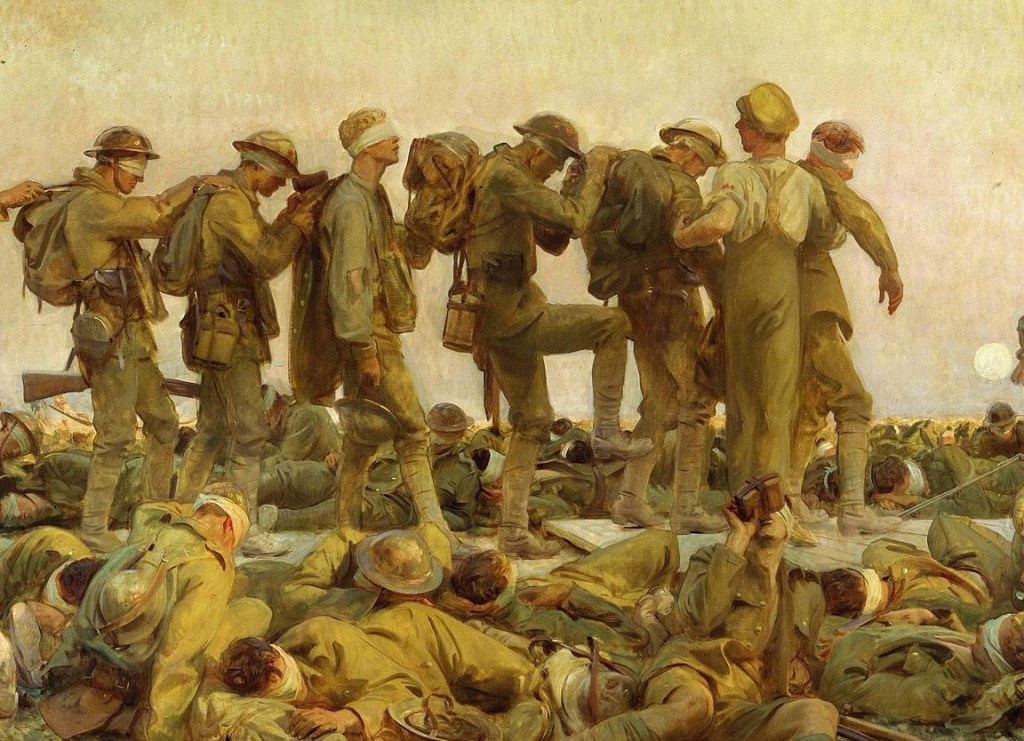
Poem: Dulce et Decorum Est by Wilfred Owen
The poem is set at the Front during the First World War, a protracted and violent struggle that was characterised by trench warfare. Life in the trenches was bleak and soldiers from both sides died in their millions. Poets such as Wilfred Owen and his friend Siegfried Sassoon resented the depiction of war as glorious and heroic, as this propaganda was generally encouraged by high-ranking officers and politicians who did not experience the fighting first-hand and were instead sending young men in their millions to meet almost certain death. This poem is a biting critique of the romanticism (think of romanticism as the opposite of reality) of war or what Owen dubs ‘the old lie’.
The poem opens with an almost cinematic portrayal of a group of soldiers returning back to their trench after a day of fighting at the Front. The poet uses two effective similes to describe the effect this fighting has had on the soldiers- they are ‘bent double like old beggars’ and ‘coughing like hags.’ Their laboured walking is brilliantly portrayed through the use of alliteration- they are ‘knock-kneed’ as they ‘trudge’ through the mud. The scene becomes even more unpleasant as the speaker describes ‘the haunting flares’ behind them. The long vowel sounds contribute to the overall sense of exhaustion and slowness and the harsh ‘k’ sound in words like ‘sacks’ ‘knock’ and ‘backs’ add to the jarring effect of the opening stanza. Words such as ‘cursed’, ‘limped’, ‘blood-shod’, ‘lame’ and ‘blind’ remind us of the effects of violence on these young men. Indeed, the men are so exhausted that they are described as ‘drunk with fatigue’ and thus do not hear the sound of ‘gas shells dropping softly behind.’
The agonisingly slow pace of the first stanza comes to an abrupt halt as the men are attacked by mustard gas. Owen skilfully changes the tense to the present and a sense of danger and immediacy is wonderfully created through the opening line: ‘Gas! GAS! Quick, boys!- An ecstacy of fumbling’. The soldier rush, albeit clumsily, to fit their gasmasks, but one soldier is not able to fit his own in time. In contrast to the long, drawn out assonance in the opening stanza, Owen now uses short vowel sounds in order to mimic the frenzied movement of the panicked soldier: ‘But someone still was yelling out and stumbling and flound’ring like a man in fire or lime.’ Indeed, to quicken the pace of these lines, Owen removed a syllable from the word ‘floundering.’ The repeated ‘l’ sounds also ensure that this image particularly stands out. We are then provided with one of the most haunting images of the poem: Owen can only watch helplessly through the ‘misty panes and thick green light’ as the unfortunate soldier ‘plunges’ at him ‘guttering, choking, drowning.’
The concluding stanza changes from the narrative first person to second person, which Owen used in order to provoke thought in his reader. He is presenting us with an horrific, unrelenting portrayal of a soldier’s death and he will not allow his reader to look away. His language becomes even more evocative and violent, as he describes the brutal final moments of the soldier. The dying man is ‘flung’ into a wagon, another reminder to us that these men are cared little about. Owen is forced to ‘watch the white eyes writhing in his face.’ He is forced to hear ‘the blood come gargling from the froth-corrupted lungs’. Owen utilises two more similes to remind us of the pain this man (and all soldiers) experiences as he dies- the blood pouring forth from his lungs is ‘obscene as cancer’ and ‘bitter as the cud’, a reference to the acidic taste in his mouth. The sores in his ‘innocent’ mouth are ‘vile.’ To conclude the poem, Owen reminds us that if we had indeed witnessed this long, painful death, we would not believe the ‘old lie’ that it is sweet and proper to die for your country. Owen sees nothing romantic, dignified nor heroic about this man’s death- he is merely another young man who will be forgotten.


 Ms Cotter's Class
Leave a comment